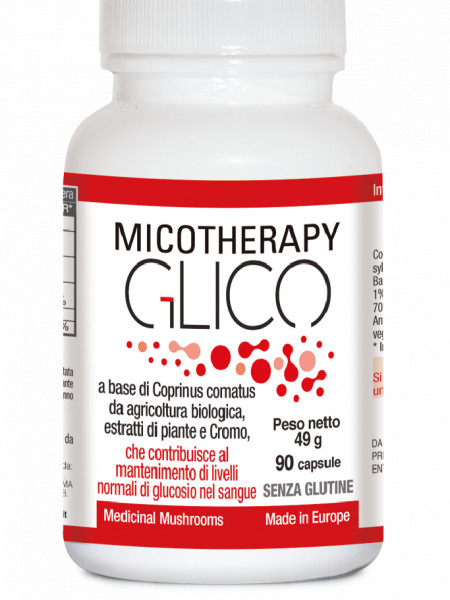
Micotherapy Glico
Micotherapy Glico es un complemento alimenticio que combina el hongo ecológico Coprinus comatus con plantas (Gymnema, Banaba, Rosa canina), Metilsulfonilmetano y Cromo. El Cromo contribuye al mantenimiento de niveles normales de glucosa en sangre y al metabolismo normal de los macronutrientes.
Formato
90 cápsulas
Modo de empleo
una cápsula 3 veces al día, una hora antes de las comidas
Propiedades
Micotherapy Glico combina el hongo Coprinus comatus con Gymnema y Banaba, plantas tradicionalmente utilizadas para el metabolismo de los carbohidratos, y con Rosa canina, fuente natural de Vitamina C, que contribuye a la protección de las células frente al daño oxidativo. El Cromo contribuye al metabolismo normal de los macronutrientes y al mantenimiento de niveles normales de glucosa en sangre.
Efectos principales
El Cromo contribuye al mantenimiento de niveles normales de glucosa en sangre Apoya el metabolismo normal de los carbohidratos y de los macronutrientes La Vitamina C contribuye a la protección de las células frente al daño oxidativo
Información nutricional
| Componentes |
Por dosis diaria |
|---|---|
| Coprinus sporophorum | 600 mg |
| Gymnema extracto seco | 300 mg |
| Aporte de ácido gimnémico | 335 mg |
| Banaba extracto seco | 300 mg |
| Aporte de ácido corosólico | 3 mg |
| Rosa canina extracto seco | 90 mg |
| Aporte de vitamina C | 63 mg |
| Metilsulfonilmetano (MSM) | 30 mg |
| Cromo | 200 mcg |
Dónde encontrar el producto
Código de parafarmacia: A923582124
Inscrito en el registro de complementos alimenticios del Ministerio de Sanidad italiano, n.º: codice 62495
Notas:
• Asatiani, Mikheil D., et al. The Shaggy Inc Cap medicinal mushroom, Coprinus comatus (OF Mull.: Fr.) Pers.(Agaricomycetideae) substances interfere with H 2 O 2 induction of the NF-κB pathway through inhibition of IκBα phosphorylation in MCF7 breast cancer cells. International journal of medicinal mushrooms 13.1 (2011).
• Bailey, C. J., et al. Effect of Coprinus comatus on plasma glucose concentrations in mice. Planta medica 50.06 (1984): 525-526.
• C Han, B et al., Vanadium uptake by biomass of Coprinus comatus and their effect on hyperglycemic mice. Biol Trace Elem Res, Jul 2008; 124(1): 35-9.
• CHan, J et al., Hypoglycemic activity of fermented mushroom of Coprinus comatus rich in vanadium. J Trace Elem Med Biol, Jan 2006; 20(3): 191-6.
• Chunchao H et al., Vanadium uptake by biomass of Coprinus comatus and their effect on hyperglycemic mice. Biological trace element research 124.1 (2008): 35-39.
• Ding, Zhongyang, et al. “Hypoglycaemic effect of comatin, an antidiabetic substance separated from Coprinus comatus broth, on alloxan-induced-diabetic rats.” Food chemistry 121.1 (2010): 39-43.
• Dotan, Nesly, Solomon P. Wasser, and Jamal Mahajna. The culinary-medicinal mushroom Coprinus comatus as a natural antiandrogenic modulator. Integrative cancer therapies 10.2 (2011): 148-159.
• G. Zhou and C Han. The co-effect of vanadium and fermented mushroom of Coprinus comatus on glycaemic metabolism. Biol Trace Elem Res, Jul 2008; 124(1): 20-7.
• Gao Z. eta l., Characterization and anti-diabetic nephropathic ability of mycelium polysaccharides from Coprinus comatus. Carbohydr Polym. 2021 Jan 1;251:117081.
• Li, Bo, et al. Glucose lowering activity of Coprinus comatus. Agro Food Industry Hi-Tech 21.3 (2010): 15-17.
• Wang G. et al., Comparison of effects of vanadium absorbed by Coprinus comatus with those of inorganic vanadium on bone in streptozotocin-diabetic rats. Biol Trace Elem Res. 2012 Dec;149(3):391-8.
Lv Y. et al., Comparison of hypoglycemic activity of trace elements absorbed in fermented mushroom of Coprinus comatus. Biol Trace Elem Res. 2009 Nov;131(2):177-85.
• Wang G. et al., Systemic treatment with vanadium absorbed by Coprinus comatus promotes femoral fracture healing in streptozotocin-diabetic rats. Biol Trace Elem Res. 2013 Mar;151(3):424-33
• Yingtao Lv et al., Comparison of Hypoglycemic Activity of Trace Elements Absorbed in Fermented Mushroom of Coprinus comatus. Biol Trace Elem Res, Mar 2009Abstract
• Zaidman, Ben-Zion, et al. Coprinus comatus and Ganoderma lucidum interfere with androgen receptor function in LNCaP prostate cancer cells. Molecular biology reports 35.2 2008: 107-117.
• Zenkova, Valentina A., et al. Antimicrobial activity of medicinal mushrooms from the genus Coprinus (Fr.) SF Gray (Agaricomycetideae). International Journal of Medicinal Mushrooms 5.1 2003.
• Zhou, Guangtian, and Chunchao Han. The co-effect of vanadium and fermented mushroom of Coprinus comatus on glycaemic metabolism. Biological trace element research 124.1 (2008): 20-27.
• Derosa G. et al., An Evaluation of a Nutraceutical with Berberine, Curcumin, Inositol, Banaba and Chromium Picolinate in Patients with Fasting Dysglycemia. Diabetes Metab Syndr Obes. 2020 Mar 3;13:653-661.
• Kim SJ. Corosolic acid ameliorates acute inflammation through inhibition of IRAK-1 phosphorylation in macrophages. BMB Rep. 2016 May;49(5):276-81.
• Klein G. et al., Antidiabetes and Anti-obesity Activity of Lagerstroemia speciosa. Evid Based Complement Alternat Med. Dec;4(4):401-7.
• Kouzi SA. Et al., Natural supplements for improving insulin sensitivity and glucose uptake in skeletal muscle. Front Biosci (Elite Ed). 2015 Jan 1;7:94-106.
• McKennon SA. Non-Pharmaceutical Intervention Options For Type 2 Diabetes: Diets And Dietary Supplements (Botanicals, Antioxidants, and Minerals). 2018 editors. Endotext [Internet]. South Dartmouth (MA): MDText.com, Inc.; 2000.
• N Stohs SJ. et al., A review of the efficacy and safety of banaba (Lagerstroemia speciosa L.) and corosolic acid. Phytother Res. 2012 Mar; 26(3):317-24.
• Al-Romaiyan A. et al., A novel Gymnema sylvestre extract protects pancreatic beta-cells from cytokine-induced apoptosis. Phytother Res. 2020 Jan;34(1):161-172.
• Gholap S and Kar A. Effects of Inula racemosa root and Gymnema sylvestre leaf extracts in the regulation of corticosteroid induced diabetes mellitus: involvement of thyroid hormones. 2003 Pharmazie 58 (6): 413–415.
• Khan J. Et al., Metabolic differentiation and quantification of gymnemic acid in Gymnema sylvestre (Retz.) R.Br. ex Sm. leaf extract and its fermented products. Phytochem Anal. 2020 Jul;31(4):488-500.
• Kiem PV et al., Five New Pregnane Glycosides from Gymnema sylvestre and Their alpha-Glucosidase and alpha-Amylase Inhibitory Activities. Molecules. 2020 May 28;25(11):2525.
• Li Y. et al., Gymnemic Acid Ameliorates Hyperglycemia through PI3K/AKT- and AMPK-Mediated Signaling Pathways in Type 2 Diabetes Mellitus Rats.
• Persaud SJ et al., Gymnema sylvestre stimulates insulin release in vitro by increased membrane permeability”. J Endocrinol 1999; 163 (2): 207–212
• Semwal DK et al., Protective and therapeutic effects of natural products against diabetes mellitus via regenerating pancreatic beta-cells and restoring their dysfunction. Phytother Res. 2020 Sep 28.
• Shanmugasundaram KR et al., Insulinotropic activity of G. sylvestre, R.Br. and Indian medicinal herb used in controlling diabetes mellitus. Pharmacol Res Commun 1982; 13 (5): 475–486
• Sugihara Y. et al., Antihyperglycemic effects of gymnemic acid IV, a compound derived from Gymnema sylvestre leaves in streptozotocin-diabetic mice. Journal of Asian natural products research 2000;2(4):321-7.
• Brownlee M, et al., Advanced glycosylation end products in tissue and the biochemical basis of diabetic complications.” N Engl J Med (1988) 318: pp. 1315-1321.
• Dakhale G. N., et al., Supplementation of vitamin C reduces blood glucose and improves glycosylated hemoglobin in type 2 diabetes mellitus: a randomized, double-blind study,” Adv Pharmacol Sci, vol. 2011, p. 195271, 2011.
• Julie C. Will and Tim Byers. Does Diabetes Mellitus Increase the Requirement for Vitamin C?. Nutrition Reviews, Volume 54, Issue 7, July 1996,
• Krone C. A. and Ely J. T. A.. Vitamin C and Glycohemoglobin Revisited. Clinical Chemistry, vol. 47, no. 1, p. 148–148, Jan. 2001.
• Sanz-González SM et al., Clinical and Molecular-Genetic Insights into the Role of Oxidative Stress in Diabetic Retinopathy: Antioxidant Strategies and Future Avenues. Antioxidants (Basel). 2020 Nov 9;9(11):E1101.
• Shi L. et al., Ascorbic acid supplementation in type 2 diabetes mellitus: A protocol for systematic review and meta-analysis. Medicine (Baltimore). 2020 Nov 6;99(45):e23125.
• G.Atmaca, “Antioxidant Effects of Sulfur-Containing Amino Acids,” Yonsei Medical Journal, Vol. 45,5,776-788,2004.
• Eun Seong J. et al., Sulfur Compounds Inhibit High Glucose-Induced Inflammation by Regulating NF-κB Signaling in Human Monocytes. 2020 May; 25(10): 2342
• Manna P, et al. Role of sulfur containing amino acids as an adjuvant therapy in the prevention of diabetes and its associated complications. Curr Diabetes Rev. 2013 May;9(3):237-48
• Asbaghi O. et al., Effects of chromium supplementation on glycemic control in patients with type 2 diabetes: a systematic review and meta-analysis of randomized controlled trials. Pharmacol Res. 2020 Jul 28;161:105098.
• Molz P. et al., Potential Ameliorative Effects of Chromium Supplementation on Glucose Metabolism, Obesity, and Genomic Stability in Prediabetic Rat Model. Biol Trace Elem Res. 2020 Jul 25.
• Östman E. et al., A novel nutritional supplement containing amino acids and chromium decreases postprandial glucose response in a randomized, double-blind, placebo-controlled study. PLoS One. 2020 Jun 24;15(6):e0234237.
• Khodavirdipour A. et al., Chromium Supplementation; Negotiation with Diabetes Mellitus, Hyperlipidemia and Depression. .J Diabetes Metab Disord. 2020 Mar 5;19(1):585-595.
Líneas de productos


