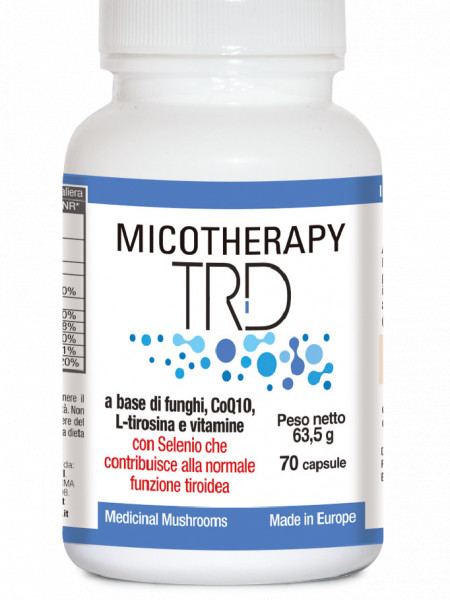
Micotherapy TRD
Micotherapy TRD es un complemento alimenticio que combina los hongos ecológicos Ganoderma lucidum y Agaricus blazei Murrill con Fucus vesiculosus, Tirosina, Zinc, Selenio, CoQ10 y Vitaminas B6, B9 y B12. Contiene Yodo y Selenio, que contribuyen al funcionamiento normal de la tiroides.
Formato
70 cápsulas
Modo de empleo
1 cápsula 3 veces al día, preferiblemente lejos de las comidas
Propiedades
Micotherapy TRD es un complemento alimenticio formulado para apoyar el funcionamiento normal de la tiroides. El Yodo y el Selenio contribuyen al funcionamiento normal de la tiroides; el Yodo contribuye además a la producción normal de hormonas tiroideas. El Selenio, el Zinc y las Vitaminas B6 y B12 contribuyen al funcionamiento normal del sistema inmunitario, y el Selenio contribuye a la protección de las células frente al daño oxidativo. Las Vitaminas B6, B9 y B12 contribuyen a disminuir el cansancio y la fatiga. Los hongos Reishi y Agaricus blazei Murrill se utilizan tradicionalmente para el bienestar del organismo.
Efectos principales
Contribuye al funcionamiento normal de la tiroides y a la producción normal de hormonas tiroideas (Yodo, Selenio) Contribuye a la protección de las células frente al daño oxidativo (Selenio) Contribuye a disminuir el cansancio y la fatiga (Vitaminas B6, B9, B12)
Información nutricional
| Componentes |
Por dosis diaria |
|---|---|
| Agaricus blazei extracto seco | 750 mg |
| Aporte de polisacáridos | 187,5 mg |
| Reishi extracto seco | 750 mg |
| L-tirosina | 300 mg |
| Fucus extracto seco | 225 mg |
| Aporte de yodo | 225 mcg |
| CoQ10 | 150 mg |
| Zinc | 15 mg |
| Vitamina B6 (piridoxina) | 9,5 mg |
| Ácido fólico (Vit B9) | 400 mcg |
| Selenio | 83 mcg |
| Vitamina B12 (cianocobalamina) | 33 mcg |
Dónde encontrar el producto
Código de parafarmacia: A973731108
Inscrito en el registro de complementos alimenticios del Ministerio de Sanidad italiano, n.º:
Notas:
• Zimmermann MB (2011). Role of iodine in human growth and development. Semin Cell Dev Biol 22: 645-65.
• Caldwell KL, et al., (2008) Iodine status of the US population, National Health and Nutrition Examination Survey 2003-2004. Thyroid, 18:1207-1214.
• Pearce, et al., (2017) Environmental Iodine Uptake Inhibitors. Iodine Deficiency Disorders and Their Elimination. Springer International Publishing, 141-153.
• Ferrari, Silvia Martina, et al. (2017). Environmental issues in thyroid diseases. Frontiers in endocrinology 8 (2017).
• Goyal I. et al., Hypothyroidism and goiter in a young male with suspected dietary iodine deficiency followed by thyrotoxicosis after iodine supplementation. AACE Clin Case Rep. 2020 Sep 26;6(1):e19-e22.
• Wol J, Chaiko IL (1948) Plasma inorganic iodide as a homeostatic regulator of thyroid function. J Biol Chem 174: 555-564.
• Patey-Pirra S, et al., (2014) Benefits and risks of iodine supplementation during pregnancy: a review of observational and experimental studiesbin mild-to-moderate iodine deficiency area. Rev Epidemiol Sante Publique 62: 65-74.
• Nazeri P, et al., (2015) Iodine nutrition status in lactating mothers residing in countries with mandatory and voluntary iodine fortification programs: An updated systematic review. Thyroid 25: 611-620.
• Taylor PN, et al., (2014) Therapy of endocrine disease: impact of iodine supplementation in mild-to- moderate iodine de_ciency: systematic review and meta-analysis. Eur J Endocrinol 170:1-15.
• Guess K, Malek L, Anderson, A, Makrides, M, Zhou SJ (2016) Knowledge and practices regarding iodine supplementation: A national survey of healthcare providers. Women Birth 30: e56-e60.
• Zava TT, Zava DT (2011). Assessment of Japanese iodine intake based on seaweed consumption in Japan: a literature-based analysis. yroid research 4: 1-1.
• Vanderpump, Mark P (2017). Epidemiology of iodine deficiency. Minerva medica 108: 116-123.
• Kim, Hye Jeong, et al. (2017) Strong association of relatively low and extremely excessive iodine intakes with thyroid cancer in an iodine-replete area. European journal of nutrition 56.3: 965-971.
• Malamos, B., et al. The serum tyrosine level as an index of thyroid function. Journal of Endocrinology 35.3 (1966): 223-228.
• W. Khalig et al., Reductions in tyrosine levels are associated with thyroid hormone and catecholamine disturbances in sepsis. Intensive Care Med Exp. 2015 Dec; 3(Suppl 1): A686.
• Schomburg L. Selenium, selenoproteins, and the thyroid gland: interactions in health and disease. Nat Rev Endocrinol. 2011;8(3):160-71.
• Triggiani V, Tafaro E, Giagulli VA, et al. Role of iodine, selenium and other micronutrients in thyroid function and disorders. Endocr Metab Immune Disord Drug Targets. 2009 Sep;9(3):277-94. Review.
• Leoni SG. et al., Selenium increases thyroid-stimulating hormone-induced sodium/iodide symporter expression through thioredoxin/apurinic/apyrimidinic endonuclease 1-dependent regulation of paired box 8 binding activity, Antioxid. Redox Signal. 24 (2016) 855–866.
• 34. Kohrle, J., et al. “Selenium, the thyroid, and the endocrine system.” Endocrine reviews 26.7 (2005): 944-984.
• H. Kamada, et al., Effects of selenium supplementation on plasma progesterone concentrations in pregnant heifers, Anim. Sci. J. 85 (2014) 241–246
• A. Singh, et al., Biochemical indices of selected trace minerals in men: effect of stress, Am. J. Clin. Nutr. 53 (1991) 126–131.
• Gärtner, Roland, et al. “Selenium supplementation in patients with autoimmune thyroiditis decreases thyroid peroxidase antibodies concentrations.” The Journal of Clinical Endocrinology & Metabolism 87.4 (2002): 1687-1691.
• Marinò M., et al. “Selenium in the Treatment of Thyroid Diseases.” European Thyroid Journal 6.2 (2017): 113-114.
• Nordio, M. “A novel treatment for subclinical hyperthyroidism: a pilot study on the beneficial effects of l-carnitine and selenium.” European Review for Medical and Pharmacological Sciences 21 (2017): 2268-2273.
• G. Lenaz et al., Structure and organization of mitochondrial respiratory complexes: a new understanding of an old subject, Antioxid. Redox Signal 12 (2010) 961–1008.
• Moncayo, Roy, and Helga Moncayo. Applying a systems approach to thyroid physiology: Looking at the whole with a mitochondrial perspective instead of judging single
• TSH values or why we should know more about mitochondria to understand metabolism. BBA clinical (2017).
• A. Ben-Meir, et al., Coenzyme Q10 restores oocyte mitochondrial function and fertility during reproductive aging, Aging Cell 14 (2015) 887–895.
• S.G. Leoni, et al., Regulation of thyroid oxidative state by thioredoxin reductase has a crucial role in thyroid responses to iodide excess, Mol. Endocrinol. 25 (2011) 1924–1935.
• P. Rani, K. Lalitha, Evidence for altered structure and impaired mitochondrial electron transport function in selenium deficiency, Biol. Trace Elem. Res. 51 (1996) 225–234
• Hartoma, R., Effect of zinc on some biochemical indices of metabolism. Annals of Nutrition and Metabolism 23.4 (1979): 294-300.
• Betsy A., et al., Zinc deficiency associated with hypothyroidism: an overlooked cause of severe alopecia, Int. J. Trichol. 5 (2013) 40–42.
• Alvarez-Salas E. et al., Mediobasal hypothalamic and adenohypophyseal TRH- degrading enzyme (PPII) is down-regulated by zinc deficiency, Int. J. Dev. Neurosci. 46 (2015) 115–124.
• Pathak R and Pathak A. Effectiveness of Zinc Supplementation on Lithium-Induced Alterations in Thyroid Functions. Biol Trace Elem Res. 2020 Aug 26.
• Ihnatowicz P, Drywień M, Wątor P, Wojsiat J. et al., The importance of nutritional factors and dietary management of Hashimoto’s thyroiditis. .Ann Agric Environ Med. 2020 Jun 19;27(2):184-193.
• Mahmoodianfard S. et al., Effects of zinc and selenium supplementation on thyroid function in overweight and obese hypothyroid female patients: a randomized double-blind controlled trial. Journal of the American College of Nutrition 34.5 (2015): 391-399.
• Ihnatowicz P. et al., The importance of nutritional factors and dietary management of Hashimoto’s thyroiditis. Ann Agric Environ Med. 2020 Jun 19;27(2):184-193
• Nechyporuk Vet al., The impact of B vitamins on the functioning of methylation cycle in the liver and the kidneys of hyper- and hypothyroid rats. Pol Merkur Lekarski. 2020 Feb 26;48(283):55-59.
• Priyadarshini R., The Prevalence of Vitamin B12 Defi ciency in Patients with Hypothyroidism. J Assoc Physicians India. 2020 Jan;68(1):44.
• Apeland T. Thyroid function during B-vitamin supplementation of patients on antiepileptic drugs.Clin Biochem. 2006 Mar;39(3):282-6.
• Diekman, M. J. M., et al. “Determinants of changes in plasma homocysteine in hyperthyroidism and hypothyroidism.” Clinical endocrinology 54.2 (2001): 197-204.
• Lien, E. A., et al. “Plasma total homocysteine levels during short-term iatrogenic hypothyroidism.” The Journal of Clinical Endocrinology & Metabolism 85.3 (2000): 1049-1053.
• Patocka J. Anti-inflammatory triterpenoids from mysterious mushroom Ganoderma lucidum and their potential possibility in modern medicine. Acta Medica 42.4 (1999): 123-125.
• Sheena, N. et al., Anti-inflammatory and anti-nociceptive activities of Ganoderma lucidum occurring in South India. Pharmaceutical biology 41.4 (2003): 301-304.
• Paterson, R. Russell M. Ganoderma–a therapeutic fungal biofactory. Phytochemistry 67.18 (2006): 1985-2001.
• Toshihiro A. et al., Anti-Inflammatory and Anti-Tumor Promoting Effects of Triterpene Acids and Sterols from the Fungus Ganoderma lucidum.” Chemistry & biodiversity 4.2 (2007): 224-231.
• Dudhgaonkar, Shailesh, Anita Thyagarajan, and Daniel Sliva. “Suppression of the inflammatory response by triterpenes isolated from the mushroom Ganoderma lucidum.” International immunopharmacology 9.11 (2009): 1272-1280.
• Joseph S. et al. Antitumor and anti-inflammatory activities of polysaccharides isolated from Ganoderma lucidum. Acta pharmaceutica 61.3 (2011): 335-342.
• Yoon, Hyun-Min, et al. Ganoderma lucidum ethanol extract inhibits the inflammatory response by suppressing the NF-kB and toll-like receptor pathways in lipopolysaccharide-stimulated BV2 microglial cells.” Experimental and therapeutic medicine 5.3 (2013): 957-963.
• Keith R. The novel antioxidant ergothioneine found in dietary mushrooms inhibits monocyte binding to human aortic endothelial cells.” The FASEB Journal 22.1
• Sit, A. S. M., et al. “Potential beneficial effect of ergothioneine in protecting endothelial dysfunction.” Basic & Clinical Pharmacology & Toxicology (2010).
Líneas de productos


